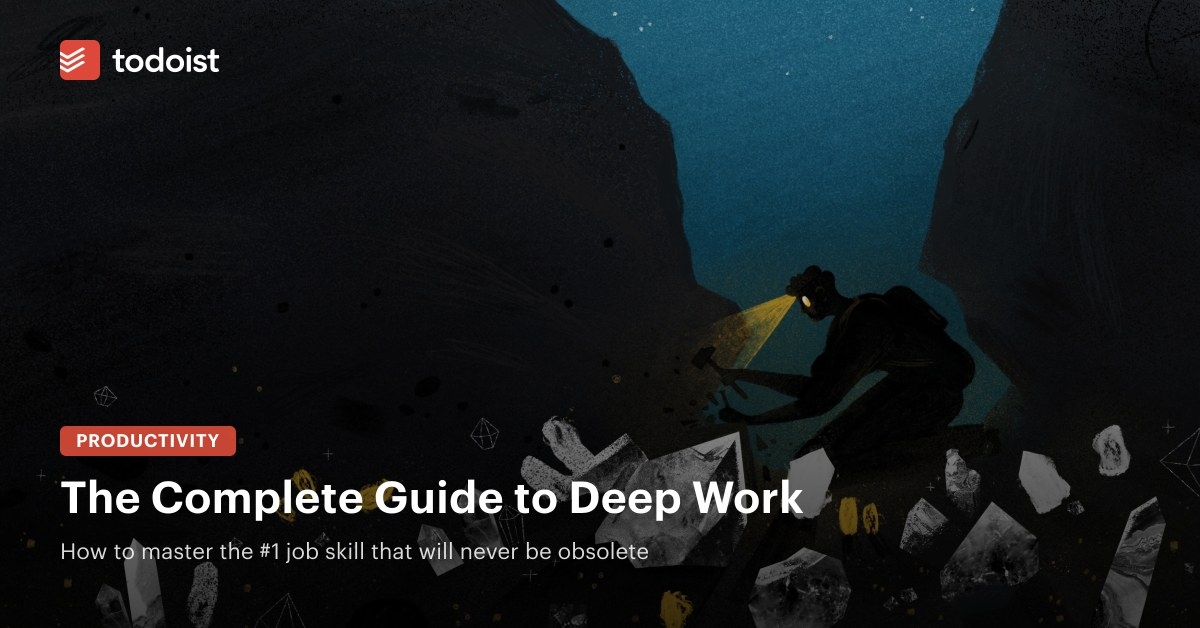
Twice each year, Microsoft co-founder Bill Gates spends a week in a woodland cabin reading and thinking. These retreats exclude email, calls, and internet access; his reading material consists of papers from Microsoft employees proposing innovations or investments.
This deliberate removal of distractions illustrates deep work: sustained concentration that supports focus and creativity. Microsoft's New Future of Work Report 2025 reports substantial individual productivity gains from AI and structured work practices. A remote retreat, however, is not necessary to make focused work part of everyday life.
What is deep work?
Deep work means concentrating without distractions so you can master difficult material and produce high-quality work quickly. Georgetown University computer science professor Cal Newport coined the term and explored it in Deep Work: Rules for Focused Success in a Distracted World.
Its defining features are:
- Uninterrupted attention: Email, notifications, and other interruptions are excluded.
- Mental challenge: The task stretches your cognitive abilities.
- Defined sessions: Focus periods typically last 60–90 minutes.
- Valuable results: The work builds skills or creates new value.
By contrast, Newport describes shallow work as logistical tasks that can be completed while distracted—what Asana calls busywork.
|
Deep work |
Shallow work |
|
Requires full concentration |
Can be done while distracted |
|
Creates new value |
Easy to replicate |
|
Improves skills |
Doesn't push cognitive limits |
|
Examples: writing, coding, strategic planning |
Examples: email, scheduling, status updates |
Asana’s research finds that coordination occupies 60% of knowledge workers’ time, rather than strategic work. Reducing that burden creates room for more consequential tasks.
Why focused work matters
Less switching, more attention
Moving between activities leaves some attention attached to the previous task. Checking your phone while writing a project proposal, for example, creates attention residue that interferes with concentration.
Research on working time shows how communication and meetings limit opportunities for focus. A 2026 study covering over 500,000 hours of remote work found that 51% of working time went to deep work tools, 34% to communication tools, and 15% to meetings.
Faster learning and stronger output
Deep concentration helps the brain reinforce learning pathways and strengthen connections between neurons, allowing them to fire faster. Research on this process suggests that such rewiring requires attention to one task without distractions.
This supports two valuable workplace abilities: learning difficult skills quickly and applying them to produce quality results. A project manager, for instance, could learn to write a project proposal and then develop a detailed proposal that secures funding.
Teams can make room for this work by agreeing on communication norms, consolidating coordination in one tool, and being deliberate about meetings.
More satisfying work
Deep work is also a form of flow: a mentally absorbing state that feels rewarding in itself. Neurological research suggests that attention shapes how people perceive their world. Devoting attention to meaningful work can therefore make daily life feel more significant.
Seven ways to establish a deep work habit
Concentration improves through consistent practice. The following approaches help you create the conditions for it.
Choose a scheduling approach you can sustain
Newport describes four ways to fit deep work into your life:
|
Philosophy |
Best for |
Time commitment |
|
Rhythmic |
Those with predictable schedules |
1–4 hours daily at set times |
|
Journalistic |
Flexible schedules with variable availability |
90+ minutes when available |
|
Monastic |
Those who can minimize all shallow work |
Most of the workday |
|
Bimodal |
Those who can dedicate full days periodically |
Full days or weeks at a time |
- Rhythmic philosophy: Reserve 1–4 hour blocks at the same time each day to establish a routine. Combine this with time blocking; most people cannot sustain more than four deep work hours daily.
- Journalistic philosophy: Use available openings, such as 90-minute gaps between meetings. This requires entering a focused state on demand, which beginners may find difficult.
- Monastic philosophy: Remove or sharply reduce shallow work throughout your life. Science fiction writer Neal Stephenson follows this approach by avoiding email and speaking engagements to concentrate on writing.
- Bimodal philosophy: Alternate extended periods of deep work—at least a full day—with time for everything else. Asana encourages No Meeting Wednesday as its version of this approach.
Stephenson explains that long, uninterrupted stretches allow him to write novels, while fragmented time substantially reduces his productivity.
Build a ritual around concentration
Research into associations suggests that the brain remembers connections between settings and activities. Repeatedly concentrating at a clean desk can help that environment become a signal to focus.
Design your ritual around four questions:
- Where? Choose a setting, such as an office with the door closed and the desk cleared.
- When, and for how long? You might reserve 90 minutes in the morning before a coffee break.
- Under what rules? Decide whether internet use is allowed and where your phone will stay.
- With what support? Prepare reference papers, coffee, food, or other materials beforehand.
Other cues might include a candle, particular music, or specific clothing.
Decide what deserves your attention
Trying to do more can leave you accomplishing less. Select the most important task for each session before you begin, then set other work aside.
- Use a prioritization approach such as the Eisenhower decision matrix, Pareto principle, or eat the frog strategy to avoid multitasking.
- Connect priorities to clear team and business goals. The SMART goal methodology or Objectives and Key Results (OKRs) can help identify which tasks matter most.
Make space in your schedule
Focused work needs protected time. Examine your existing commitments before adding more:
- List your work activities and estimate how much time goes to deep versus shallow work.
- Score each meeting’s value from 1–5 and identify those that could become asynchronous updates.
- Use timeboxing for focused sessions and time blocking to batch shallow tasks such as email.
Reduce opportunities for distraction
Asana’s research reports that 80% of knowledge workers keep their inbox open while working, and 3 in 4 employees feel daily pressure to multitask. To protect attention:
- Disable notifications with Do Not Disturb, or close email and messaging apps entirely. Review notifications at your next break.
- Make focus the default by scheduling specific windows for distractions rather than repeatedly trying to regain concentration.
- Choose tools that reduce switching. Asana’s research finds that knowledge workers move between 10 apps 25 times per day. A project management tool that integrates with business tools can provide a central source of truth.
Protect time to recover
Daily rest helps prevent burnout and makes concentration sustainable. Newport recommends a firm daily stopping time and keeping weekends free of work. After stopping, avoid checking Slack, mentally drafting emails, or rehearsing meetings.
If switching off is difficult, finish the day with this shutdown procedure:
- Check your inbox once more for urgent matters.
- Decide how to address unfinished tasks tomorrow.
- Look over the next day’s schedule.
Allow 10–20 minutes for this routine so you can disconnect with greater peace of mind.
Track goals and progress
When psychologists compared motivational techniques, goal setting ranked among the most effective. Goals support intrinsic motivation—the internal drive to succeed.
Newport recommends a scoreboard recording daily deep work hours. Set short-term targets for daily focus and longer-term targets for building capacity, using SMART goals or Objectives and Key Results (OKRs) to make progress measurable.
Develop concentration gradually
Consistency matters more than perfection. Newport’s second rule encourages embracing boredom: concentration must be trained, including during idle moments. Resisting the urge to check your phone while waiting in line is one small way to practice.
- Beginners: Aim for about 1 hour of deep work per day.
- Intermediate: Increase to 2–3 hours over several weeks.
- Advanced: Build toward the 4-hour daily maximum over several months.
Be patient rather than pushing too hard too quickly. Avoiding toxic productivity helps keep the habit sustainable. Deep work is not only about output; it can also make challenging work feel energizing and rewarding.
Reducing team busywork supports this shift. Asana brings coordination into one place so teams can spend less time managing work and more time on high-impact tasks.
Common questions about deep work
How much deep work is realistic each day?
Most people can sustain 1–4 hours, with beginners starting at about one hour. Regular practice matters more than marathon sessions.
Can teams practice it together?
Yes. Shared focus periods, including meeting-free days, work best within a culture that respects and protects uninterrupted time.
Which tasks count as deep work?
Strategic planning, complex writing, and learning new skills are examples of cognitively demanding work requiring sustained attention. Tasks you can do while distracted are shallow work; those needing your full attention are deep work.
When might concentration improve?
Most people notice meaningful improvements after 4–6 weeks of daily practice. Begin with 60–90 minute sessions and extend them gradually as concentration develops.